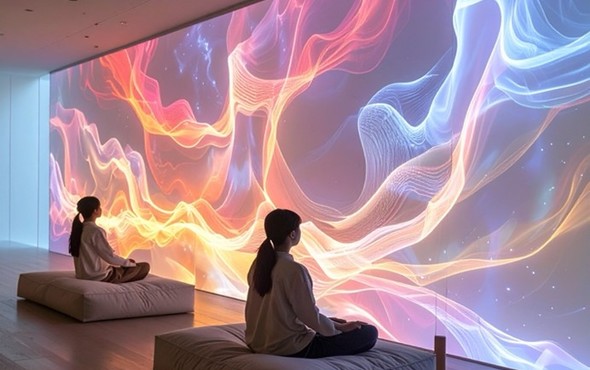
The proposed workshop adopts a research-based learning approach and focuses on the development of sensitive and cognitively immersive “therapeutic” experiences—particularly in the context of art therapy—grounded in mental health and motor disability research. Drawing on scientific literature and current health studies, each experience should offer a beneficial sensorial (e.g., visual, auditory) and/or cognitive dimension designed to address a specific pathology, including mental health conditions such as anxiety, depression, autism spectrum disorders, post-traumatic stress disorder, and eating disorders, among others.
Through this process, students will have the opportunity to discover and explore the potential impact of art therapy on these conditions, following the identification and analysis of high-quality research relevant to these topics.
Learning objectives:
At the end of the workshop, students must be able to:
- Identify how research on mental health and art therapy integrate into a multidisciplinary community;
- Communicate with colleagues from any other fields;
- Combine the knowledge they have in different areas to address a holistic health problem;
- Build a sensitive and cognitive immersive environment dedicated to a target pathology, to improve well-being of patients.
Tentative calendar
16-Feb | 23-Feb | 2-Mar | 9-Mar | 16-Mar | 23-Mar | 30-Mar |
17-Feb | 24-Feb | 3-Mar | 10-Mar | 17-Mar | 24-Mar | 31-Mar |
18-Feb | 25-Feb | 4-Mar | 11-Mar | 18-Mar | 25-Mar | 1-Apr |
19-Feb | 26-Feb | 5-Mar | 12-Mar | 19-Mar | 26-Mar | 2-Apr |
20-Feb | 27-Feb | 6-Mar | 13-Mar | 20-Mar | 27-Mar | 3-Apr |
21-Feb | 28-Feb | 7-Mar | 14-Mar | 21-Mar | 28-Mar | 4-Apr |
22-Feb | 1-Mar | 8-Mar | 15-Mar | 22-Mar | 29-Mar | 5-Apr |
Content and Methodology
The proposed workshop adopts a research-based learning approach and focuses on the development of sensitive and cognitively immersive “therapeutic” experiences—particularly in the context of art therapy—grounded in mental health and motor disability research. Drawing on scientific literature and current health studies, each experience should offer a beneficial sensorial (e.g., visual, auditory) and/or cognitive dimension designed to address a specific pathology, including mental health conditions such as anxiety, depression, autism spectrum disorders, post-traumatic stress disorder, and eating disorders, among others.
Through this process, students will have the opportunity to discover and explore the potential impact of art therapy on these conditions, following the identification and analysis of high-quality research relevant to these topics.
Short description of methodology:
ONLINE SESSIONS (16h):
- Basics (2h): leads for scientific intelligence on mental health / art therapy /immersive technology (which stimuli for which pathology); short presentation of the state-of-the-art on immersive tools
- navigating in TOUCHDESIGNER (2*2h) derivative.ca, a free digital arts development environment, easy-to-handle and agile
- Problem definition (2h): definition of 6 or 7 teams/projects (choice of the pathology to investigate)
- Ideation (3*2h):development/ online follow-up.
ONSITE SESSION from 30/3 till 3/4 April 2026: full practical session (35h) in UPSaclay
- Iterative Ideation and Prototyping (DELIVERABLE): we aim at obtaining 6 or 7 immersive experiences, either as interactive projections, either as VR/AR applications - NB: depending on the students’ skills, one to three teams will also use VR programming
- iterative development to be continued even after the course
- first prototype: mid-term evaluation by patients could be proposed (use cases), allowing codesign. Test patients might be identified at Université Paris-Saclay.