Date
6 Apr 2027 - 27 Apr 2027
Location
Online
Host university
University of Alcalá (UAH)
Mode
Online
WP
WP 2
Target groups
Master students,
Undergraduate students
Reference code
EUG2_T2_1_0242
Type of event
Course
Recognition
Transcript of records - ECTS
Language
English
Recruitment of participants
Qualitative Assessment
Number of open spots
36
Evaluation criteria
40% - Academic / Professional Merit
30% - Motivation
30% - Language
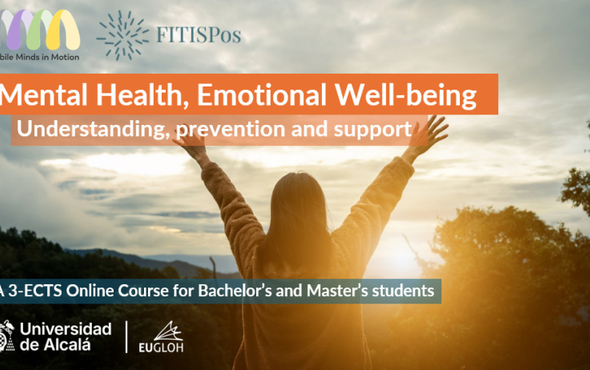
This course introduces Bachelor’s and Master’s students to key concepts and practical approaches related to mental health and emotional well-being. It combines general mental-health literacy with prevention, emotional awareness, coping and support, and uses university life and international mobility as relevant contexts of application.
The course follows a four-stage progression: understand, recognize, manage & prevent, and apply & support. International mobility is considered across the full mobility cycle (before departure, during the stay abroad and after return) with attention to emotional adjustment, stressors, protective factors, support systems and help-seeking.
The course is educational and preventive. It does not provide clinical training, diagnosis, or therapy. Participants are not required to disclose personal mental-health experiences or health information.
Prerequisites and recommendations
- Open to Bachelor’s and Master’s students from different academic backgrounds.
- No previous training in psychology or mental health is required.
- Interest in mental health, emotional well-being, university life and/or international mobility is recommended.
- Working proficiency in English sufficient to follow discussion, use course materials, and complete written activities.
The course will award 3 ECTS to participants.
Content and Methodology
The course follows an interactive, student-centred and practice-oriented approach. Short conceptual inputs are combined with guided reflection, case and scenario analysis, small-group discussion, practical exercises and the use of selected academic, institutional and Mobile Minds in Motion (MMM) resources.
Independent work is used to prepare, consolidate, and extend the synchronous sessions. It may include selected readings and multimedia materials, short reflective or applied activities, and a final integrative task. Personal disclosure is not required; hypothetical scenarios may be used where appropriate.