Embedding Climate Action into Strategy and Governance
FEP’s climate strategy is aligned with the United Nations Sustainable Development Goal 13 — Climate Action, which was selected as the central theme for the 2025/2026 academic year. A major milestone in this process was the comprehensive inventory of greenhouse gas emissions across Scopes 1, 2 and 3, providing the evidence base for the development of a Carbon Neutrality Roadmap towards 2030. This is complemented by continuous monitoring of key environmental indicators, including energy and water consumption and recycling rates, strengthening data-driven decision-making. These efforts have been externally recognised through the “Coração Verde” Certification by LIPOR and the achievement of Level 4 — Transforming School — in the student-led Positive Impact Rating.
Education and Capacity Building for the Climate Transition
Education is a cornerstone of FEP’s climate action. Sustainability and climate-related topics are increasingly integrated across degree programmes, alongside the creation of a dedicated curricular unit on climate action. In parallel, workshops, seminars and awareness-raising initiatives engage students, academics and staff in critical discussions on climate policy, sustainable development models, and organisational responses to climate risks.
Research, Partnerships and Broader Societal Impact
Research and societal engagement further reinforce FEP’s contribution. Initiatives such as the FEP Research Meeting in Sustainability foster interdisciplinary dialogue on climate and sustainability challenges, while partnerships with public, private and civil society organisations strengthen collective action. As a signatory of the Porto Climate Pact and other commitments, and through initiatives such as the UBike programme, FEP actively supports local and international climate efforts, including sustainable mobility.
Engaging the Community: A Shared Responsibility
Community engagement is central to this approach. Participatory mechanisms, such as open sustainability surveys, and flagship initiatives — including Sustainability Day 2025, European Week for Waste Reduction 2025 (focused on electronic waste), Sustainability Week 2026, and EUGLOH webinars — promote shared learning, reflection and action across the academic community.
The Campus as a Living Lab for Sustainability
FEP’s campus functions as a living lab for climate action, supported by inclusive governance structures involving leadership, a Sustainability Unit and a multi-stakeholder Sustainability Committee. Practical measures include the transition to LED lighting, the installation of photovoltaic panels in partnership with the Faculty of Psychology and Educational Sciences, and strengthened circular economy practices, such as organic waste collection and composting. The FEP REEEnova initiative, developed during the European Week for Waste Reduction, exemplifies this approach: through partnerships with local organisations and students, 260 small electronic devices were collected, avoiding an estimated 4 tonnes of CO₂ equivalent emissions.
Looking Ahead
Looking ahead, FEP remains committed to strengthening its Carbon Neutrality Roadmap, enhancing impact monitoring, expanding education and research, and deepening community engagement. By integrating strategy, knowledge creation and concrete action, FEP seeks to contribute meaningfully to a more sustainable and equitable future, while educating responsible leaders for the climate challenges ahead.
Claudia Ribeiro is Associate Dean for Sustainability & Impact, Quality & Accreditations, and Finance President of the Sustainability Committee, as well as Professor in Finance at FEP.
Ana Carvalho de Matos works in Social Responsibility and Sustainability at FEP and has a background in psychology.
Climate Action at FEP: A Strategic and Community-Driven Commitment
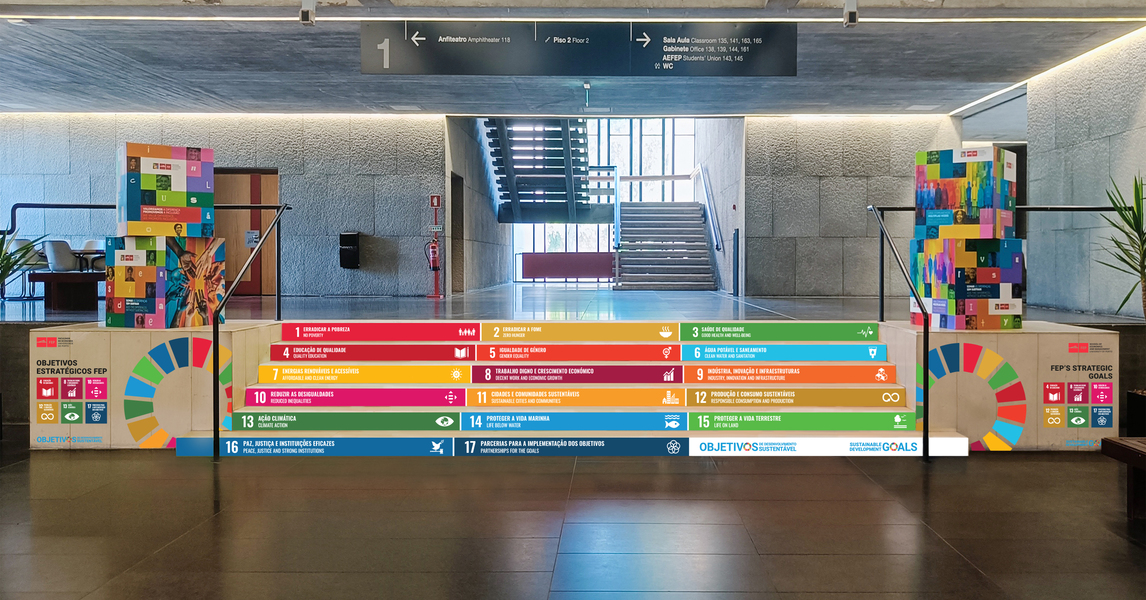
Photo: FEP – School of Economics and Management of the University of Porto