You think the world needs to change? Then, what do you think about:
- Installing simple toilets in the world’s largest slums in Kenya and India.
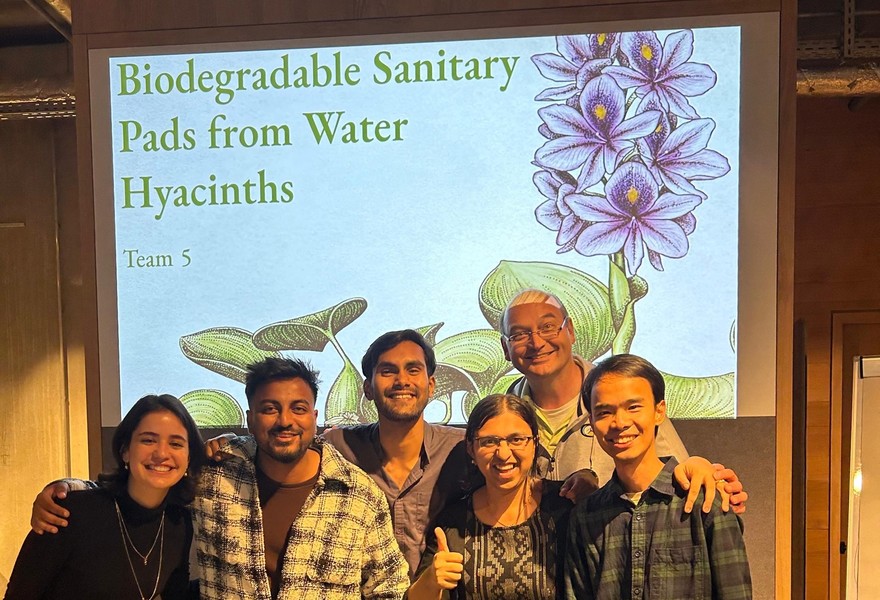
- Turning invasive species like water hyacinths into sanitary pads for poor women (India) or biofuel for poor families (Kenya, Lake Victoria).
- Educating poor women for self-employment in Nigeria and the Philippines.
- Cleaning up rivers and beaches from plastic pollution with recycling in Guatemala, Ghana, Malaysia, and Indonesia.
- Launching schools for the blind in India.
- Introducing indigenous species like African Nightshade back into food farming in Kenya.
- Changing the rice production value chain towards directly seeded rice that requires less of the disappearing water supplies in Jammu and Kashmir.
- Designing and implementing sustainable water management infrastructure in the Konso region of Ethiopia.
What all these great local initiatives have in common is that they are part of our interdisciplinary startup course at the University of Hamburg. Together with the International Sustainability Academy, we accompany about 20 sustainability projects across 15 countries (ISA, https://www.isa-germany.com/en/impact/). In the course, we team up aspiring entrepreneurs from emerging economies with interdisciplinary student teams from the University of Hamburg. Together, they design, refine, and implement the project.
Why startups? Startups are often the best way to turn innovations into reality. Startups are not tied to legacy conventions and organizations, can move faster, learn from mistakes, and adapt quicker to market developments. That is no different for combatting climate change and fostering social change.
Why this approach? Climate Change is a global challenge that requires “1,000 steps in 1,000 places,” not just a few big ones in a few developed economies which are most likely less severely affected. The same pattern holds for social changes, like for example educating children and women better as well as striving for more diversity and better inclusion. At the same time, we need to educate our next generations in how to work together globally, how to make such endeavors financially viable, learn from each other, and make them realize that we are all in the same boat. The first students already went abroad to help establish and grow the startups on spot. We could not be prouder of this great flock of young entrepreneurial people. You need hope and motivation, look at them. As Michelle Obama says: “Do not complain. Do something!”
Kay Peters is Professor of Marketing at the Business School, University of Hamburg. He holds a Visiting Professor of Marketing position at the University of Davis, California. Currently, he serves in the Academic Council of the American Marketing Association (2022-2025) and will join its Executive Committee for the term 2025-2029. He has been a member of INFORMS’ ISMS board in 2023 and was the Chairman of Europe’s EMAC Annual Conference 2019 (2016-2019). As a co-founder of several startups, he focuses on sustainability and AI startups since 2018. He coaches AI startups in the US and Europe, and sustainability startups across the globe.